
The Institute for Justice’s flagship forfeiture report, Policing for Profit, grades the forfeiture laws of each state and the federal government and demonstrates how financial incentives to seize property, in combination with weak protections for property owners, put people’s property at risk. IJ has also published reports exposing the bad data in Indiana’s forfeiture reports, surveying victims of Philadelphia’s forfeiture machine, and casting doubt on forfeiture’s public policy rationales, among other forfeiture research.
Policing for Profit
The Abuse of Civil Asset Forfeiture
4th Edition
MARCH 2026
By Lisa Knepper, Jason Tiezzi, Matthew P. West, Ph.D., Elyse Pohl and Mindy Menjou
In the 2024 case Culley v. Marshall, the Supreme Court reaffirmed that the Constitution guarantees a timely hearing in court when a person’s property is seized for civil forfeiture. Unfortunately, as this fourth edition of Policing for Profit finds, civil forfeiture procedures frequently fail to deliver on this promise, and this lack of due process compounds long-standing problems documented in earlier editions.
Do Americans support Forfeiture?
Do you support or oppose civil forfeiture?
As you may or may not know, “civil forfeiture” allows law enforcement officials to seize cash, cars, or other property if they suspect it is involved in a crime, even if the property owner has not been convicted or charged with a crime. Given this, to what extent do you support or oppose “civil forfeiture?”
- 8% – Strongly support
- 17% – Somewhat support
- 23% – Somewhat oppose
- 36% – Strongly oppose
- 15% – No opinion
Do you support or oppose allowing law enforcement agencies to use forfeited property or its proceeds?
Federal law allows law enforcement agencies to keep 100 percent of proceeds from property that has been forfeited. To what extent do you support or oppose allowing law enforcement agencies to use forfeited property or its proceeds for their own use?
- 7% – Strongly support
- 16% – Somewhat support
- 19% – Somewhat oppose
- 44% – Strongly oppose
- 15% – Don’t Know/No opinion
Do you support or oppose allowing law enforcement agencies to use forfeited property or its proceeds?
States like Minnesota and others have recently passed laws limiting the use of civil forfeiture, but legislators left in place a provision allowing local law enforcement to work with federal officials to bypass the tougher state law. Once federal prosecutors forfeit the property, they give 80 percent back to the local officials. Do you agree that state law enforcement officials should be allowed to participate in and benefit from forfeitures that are not permitted under state law?
- 7% – Strongly agree
- 23% – Somewhat agree
- 28% – Somewhat disagree
- 41% – Strongly disagree
IJ’s Civil Forfeiture Research
-
Policing for Profit
March 24, 2026In the 2024 case Culley v. Marshall, the Supreme Court reaffirmed that the Constitution guarantees a timely hearing in court when a person’s property is seized for civil forfeiture. Unfortunately, as this fourth edition of Policing for Profit finds, civil forfeiture procedures frequently fail to deliver on this promise, and this lack of due process compounds long-standing problems documented in earlier editions. -

Forfeiture Transparency and Accountability
January 16, 2019Most civil and criminal forfeiture activity happens with little legislative or public oversight. So does most spending from forfeiture funds. This report examines forfeiture reporting requirements and practices for all 50 states, as well as the District of Columbia and the U.S. departments of Justice and the Treasury. It finds that forfeiture programs nationwide suffer […]
-
Bad Data
November 6, 2025Every year, Indiana prosecutors produce reports for lawmakers detailing forfeiture activity in the state, but Bad Data shows these reports should be taken with a multimillion-dollar grain of salt. This study finds nearly 2,000 forfeiture cases worth more than $10 million over six years that were never reported, and the problem was worse in counties that farm […] -
Forfeiture in Arizona Before Reform
January 8, 2025In 2021, the Arizona Legislature enacted sweeping forfeiture reforms. The reforms were motivated by concerns that forfeiture was being used to take property like cash and cars from ordinary people who had never been convicted of any crime, with little transparency or accountability. While it is too soon to say whether the 2021 reforms are working […] -
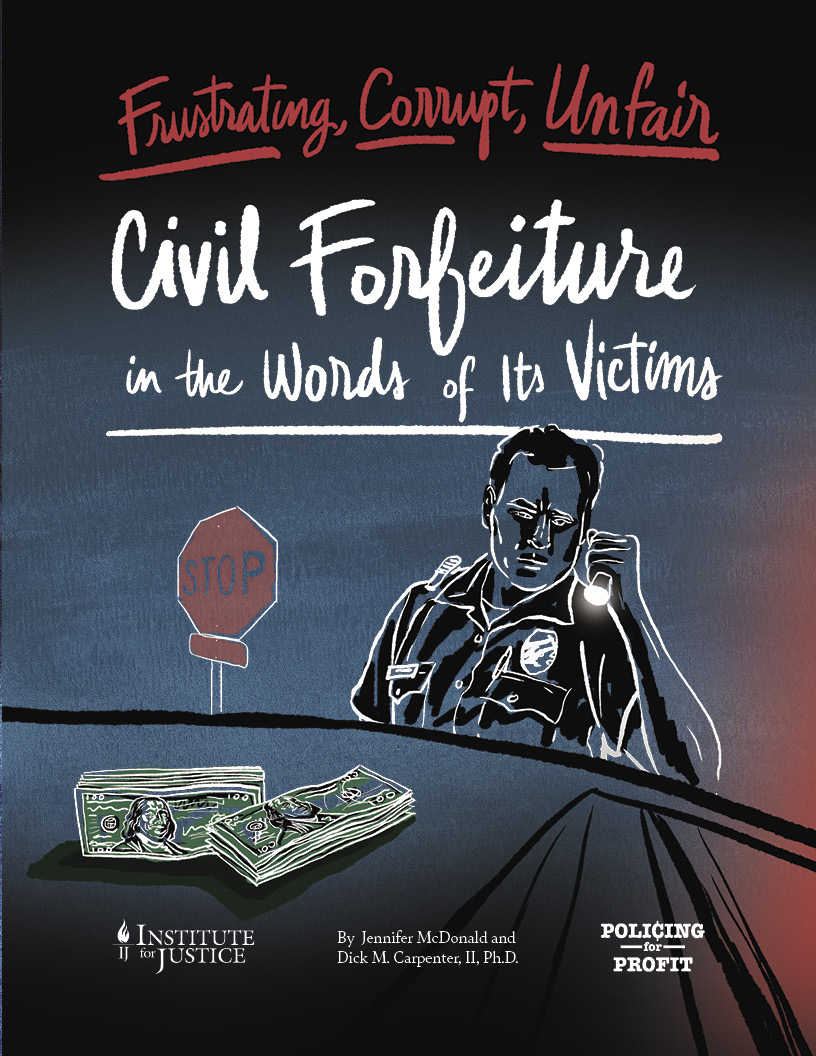
Frustrating, Corrupt, Unfair
October 20, 2021Victims of civil forfeiture call it frustrating, corrupt and unfair. This first-of-its-kind survey describes the experiences of victims of one civil forfeiture program, Philadelphia’s. It finds victims typically came from disadvantaged communities, and they had extreme difficulty trying to fight the forfeiture of their property, even when innocent. It also suggests the program did little […] -
Does Forfeiture Work?
February 10, 2021Forfeiture is a controversial tool police and prosecutors use to take and keep people’s cash, cars and even homes under the guise of fighting crime. This study is the first to look at whether state forfeiture actually fights crime or is instead used to “police for profit.” Looking at data from five states that use […] -
Jetway Robbery
July 16, 2020Law enforcement agencies routinely seize currency from travelers at airports nationwide using civil forfeiture—a legal process that allows agencies to take and keep property without ever charging owners with a crime, let alone securing a conviction. This study is the first to examine airport currency seizures by Department of Homeland Security agencies. It is also […] -
Fighting Crime or Raising Revenue?
June 9, 2019This study—the most extensive and sophisticated of its kind—combines more than a decade’s worth of data from the nation’s largest forfeiture program, the Department of Justice’s equitable sharing program, with local crime, drug use and economic data from a variety of federal sources. Results are clear: Forfeiture has no meaningful effect on crime fighting, but […] -
Forfeiture in Arizona
December 10, 2018In 2017, Arizona adopted incremental but important bipartisan reforms of the state’s civil forfeiture system, including new transparency requirements for forfeiture. The first full year of these new reports—for Fiscal Year 2018—is already illuminating. The Institute for Justice’s analysis of these reports finds evidence of forfeiture abuse in Arizona. -
Civil Forfeiture, Crime Fighting and Safeguards for the Innocent
December 7, 2018In 2017, the Department of Justice revived a controversial federal forfeiture program the previous administration had sharply curtailed. Using the DOJ’s own data, this paper finds that the DOJ cannot substantiate its claim that civil forfeiture fights crime. It also concludes that the DOJ’s new safeguards are unlikely to provide meaningful protection to innocent property owners. -

Seize First, Question Later: The IRS and Civil Forfeiture
February 1, 2015Thanks to federal civil forfeiture laws, the Internal Revenue Service has seized millions of dollars from thousands of Americans’ bank accounts without proof of criminal wrongdoing. The IRS claimed the funds were illegally “structured”—deposited or withdrawn in small amounts to evade federal reporting requirements imposed on banks—and simply took the money. -
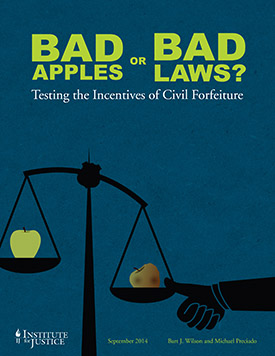
Bad Apples or Bad Laws?: Testing the Incentives of Civil Forfeiture
September 8, 2014Critics of civil forfeiture have long argued that allowing law enforcement to take property and pocket the proceeds creates incentives to put profits ahead of justice. Chapman University economist Bart J. Wilson and co-author Michael Preciado designed a cutting-edge experiment to see whether the rules of civil forfeiture in fact change behavior, and if so, how.
Our Goal:
End Civil Forfeiture
We are the Institute for Justice, a non-profit civil liberties law firm that defends private property rights across the country.
The Institute for Justice aims to curtail, and ultimately, abolish civil forfeiture, one of the gravest abuses of power in the country today. IJ has filed more than two dozen cases challenging civil forfeiture nationwide. In 2019, IJ secured a landmark victory at the U.S. Supreme Court when it ruled unanimously in Timbs v. Indiana that the Eight Amendment’s Excessive Fines Clause protects Americans against state and local forfeitures.